

Standing Desk Myths: What the Research Actually Says
We sell height adjustable standing desks, so read what follows with that in mind. The standing desk myths worth clearing up are mostly the ones our own industry put there, and the honest version is duller than the sales copy. It is also the version that leaves you with a desk you still use in a year.
The four claims that need trimming
1. Standing burns a serious number of calories
It burns a few more than sitting. Not a few hundred, a few. Across a year of working days that is a real number and I am not going to pretend otherwise, but it is nowhere near the scale of any actual change to what you eat or how much you walk. Buy a standing desk for how you feel at three in the afternoon, not for what it does to the scales.
2. Sitting is the new smoking
A good line, and it has outrun its evidence by some distance. The research that gets quoted for it usually measures total sitting across a whole day, including the sofa and the commute, not the eight hours at a desk in isolation. Sitting still for very long stretches is worth avoiding. Comparing it to a pack a day tells you more about headline writing than about health.
3. So you should stand all day instead
Nobody who has worked a shift on their feet has ever believed this one. Standing for eight straight hours brings its own complaints, mainly in the feet, calves and lower back, and shop and hospitality staff could have told the office trade about it years ago. Swapping one fixed position for a different fixed position is not progress, it is just a different ache.
4. There is a perfect posture and the desk will give it to you
There is not. The most useful thing anyone has said to me about this is that the best posture is the next one. Changing position every so often does more good than getting any single position exactly right, which is a relief, because nobody holds a textbook posture for more than about four minutes anyway.
What actually helps
Movement, in small amounts, several times a day. That is the whole of it, and it is why the mechanism matters more than the marketing. The desk that gets used is the one where changing height is easier than deciding not to bother.
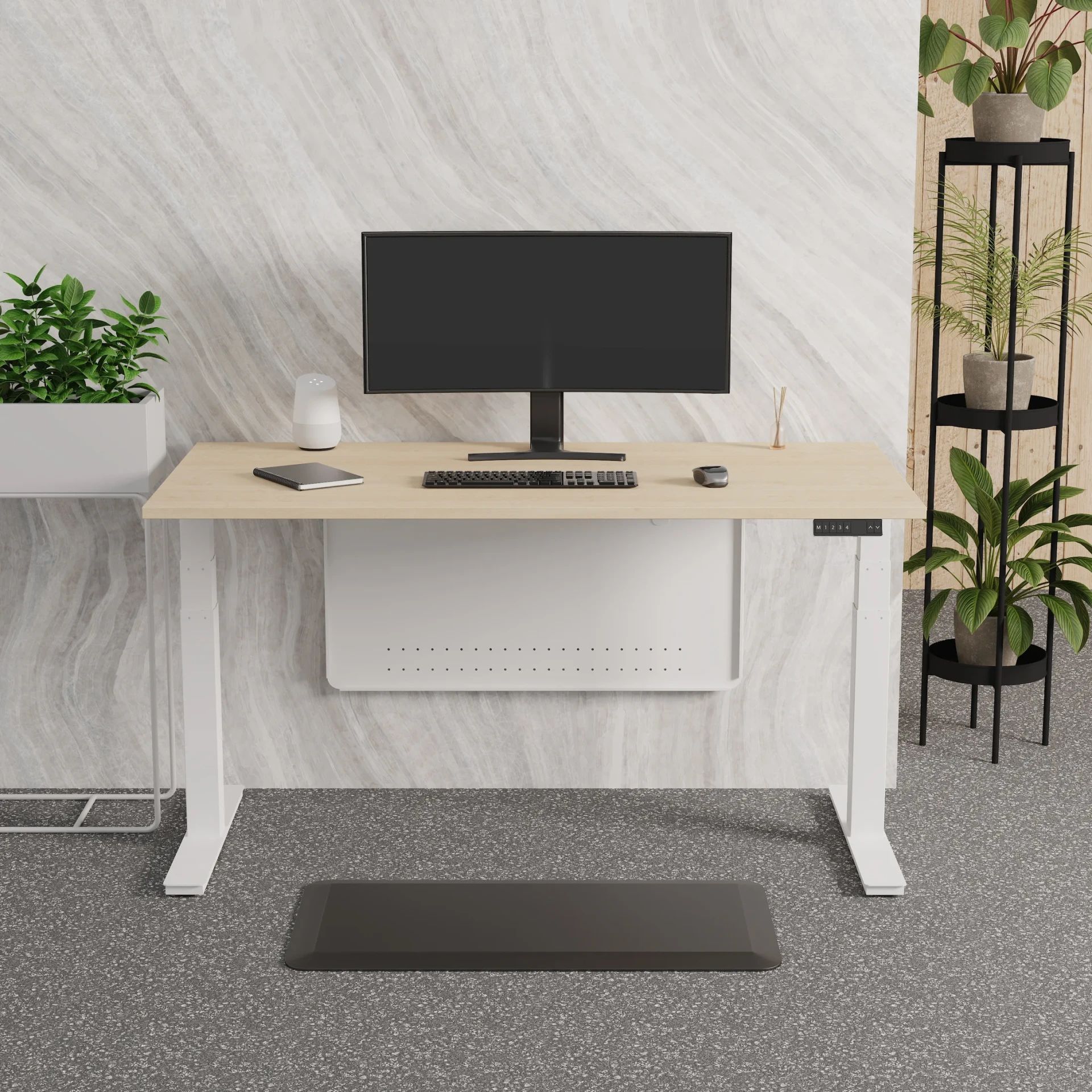
Take the Air dual motor desk as a worked example. It travels from 66.5cm to 131.5cm, and the frame moves at 38mm per second. That is 65cm of travel, so roughly seventeen seconds from its lowest point to its highest, and far less for the shift most people actually make. Seventeen seconds is a low enough price to pay three or four times a day. A hand crank, on a desk you use every day, is not.
The same logic is why standing desks with memory presets are worth the small premium if you can stretch to them. One button, no fiddling to find the right height again, no talking yourself out of it because the desk needs babysitting on the way up. Presets are the difference between a feature and a habit.
Two boring things that matter more
Get the screen right. When you stand up, the top of the monitor should still be at about eye level, which for most people means the screen has to come up as well as the desk. A standing desk with a laptop flat on it just moves the neck problem to a new height.
And do not neglect the chair, because you will still be sitting for most of the day. A standing desk paired with a tired task chair is the wrong way round: the hours you spend sitting are the ones doing the damage, and that is where the money usually works hardest. If the budget only stretches to one of the two, buy the chair first.
None of that is as exciting as the version where a desk fixes your back. It has the advantage of being true, and of costing less.
Contents

Web Developer
Keeps the site quick, honest and free of the usual dark patterns.