

Product Photos, 3D Models, and Why We Bother
The most common question in office furniture is one that a photograph almost never answers: what does the back look like? Or the underside, or the join where the leg meets the top, or how a fabric actually reads in the flesh rather than in a studio. An office furniture 3D view answers all of those in about four seconds, which is why we have been quietly building them for months.
Here is how the product pages get made, and why we spend so long on the part nobody is supposed to notice.
Supplier photographs are a starting point
Every manufacturer sends photographs, and they vary wildly. Some are beautiful. Some are a JPEG from 2011 with a shadow burned into the background. Some ranges have one photograph for forty variants, so the white desk and the oak desk are both represented by a grey one.
We clean up what we get, we standardise the framing so a grid of products does not look like a jumble sale, and we file every image against the exact variant it belongs to. That last bit is the unglamorous work: making sure that when you pick the white frame, you see the white frame.
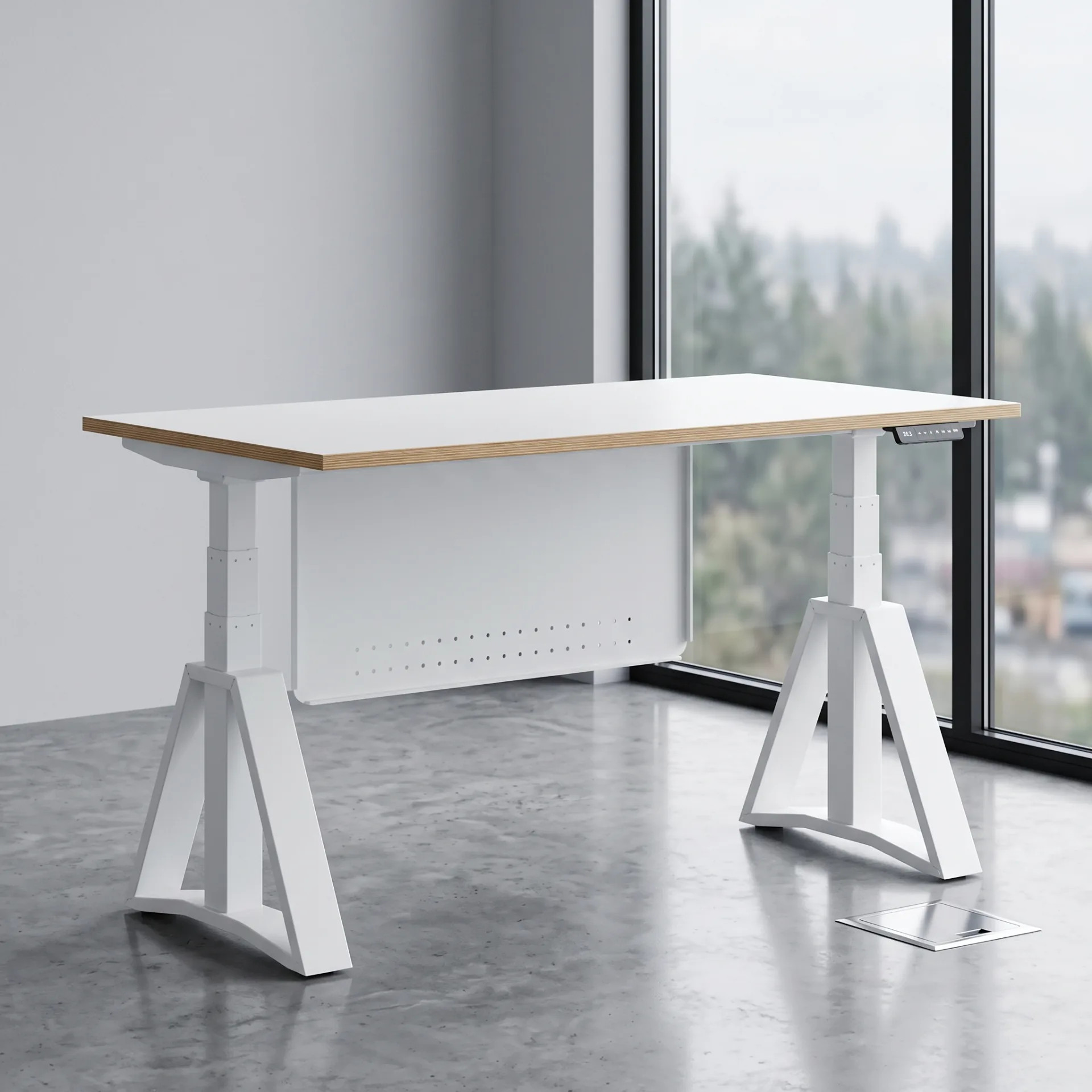
Why we build the 3D models
A photograph is one angle that somebody else chose. A 3D model is every angle, chosen by you. On the Oslo Air Piste desk you can turn it round, look underneath, and see how the foot actually meets the floor, which is the sort of thing that matters when it has to sit against a skirting board.
They earn their keep in three ways:
You can see the parts photographs hide. Cable ports, the shape of the foot, how the frame joins the top, what the back of a chair looks like when it is against a wall.
Finishes change on the model. Pick a different top or frame colour and the model changes with it, so you are looking at the thing you would actually receive.
You can put it in your own room. The view in your room button opens it on a phone and stands it on your floor at the real size, which settles arguments about whether a 1600 fits far quicker than a tape measure and an optimist.
The work behind one model
Getting a model to look right is fiddly in ways I did not expect. A wood grain has to run the correct way along a desk top, and a model that was built for a catalogue render often has the grain running across it, or scaled so the oak looks like plywood at one end and veneer at the other.
Then there is size. A model has to be exactly the size the real desk is, because when somebody stands it in their office on a phone, a 5% error is 8cm of desk that is not there. We check the dimensions of the model against the specification table, and if they disagree, the model is wrong.
None of this is visible when it works. That is rather the standard: if you never think about the 3D view and simply come away knowing what the desk looks like, it has done its job.
What is next
More models, mostly. Every range we add gets photographed properly first and modelled where the geometry justifies it, which is most desks, most storage and a growing number of chairs. The height adjustable desk range is the furthest along, so it is the best place to have a look at what we mean.
If you find a product where the images are poor or the model looks off, tell us. We would far rather hear it from you than leave a bad photograph up for another six months because nobody mentioned it.
Contents

Web Developer
Keeps the site quick, honest and free of the usual dark patterns.