

Sitting All Day? Your Chair Setup Checklist
A good chair set up badly is a bad chair. I see it on every visit: a decent task chair, bought with care, still on the factory settings because nobody had ten minutes and a reason. This is your reason. Office chair setup is five adjustments, in order, and it takes less time than making a coffee.
Do it once, properly, and then leave it alone. If you share desks, do it every morning. It gets quicker.
One thing before you start. Set your desk height first. Your chair should be adjusted to the desk, not the other way round, and we wrote about setting your desk height before your chair earlier in the year if you want the long version.
The five adjustments, in order
1. Seat height
Sit back in the chair with your feet flat on the floor. Your knees should be level with your hips or a touch lower, and your forearms should rest flat on the desk with your shoulders down. If your feet dangle, lower the seat. If your knees sit higher than your hips, raise it. The lever for this is almost always the right-hand one under the seat, and it works best when you take your weight off the chair to go up and sit into it to go down.
Why it matters: everything else is measured from here. Get the height wrong and the arms, the lumbar and the tilt all end up compensating for it.
2. Seat depth
Sit right back so your lower back touches the backrest. There should be a gap of two or three fingers between the front edge of the seat and the back of your knees. Too deep and you perch forward and lose the backrest entirely. Too shallow and your thighs are unsupported.
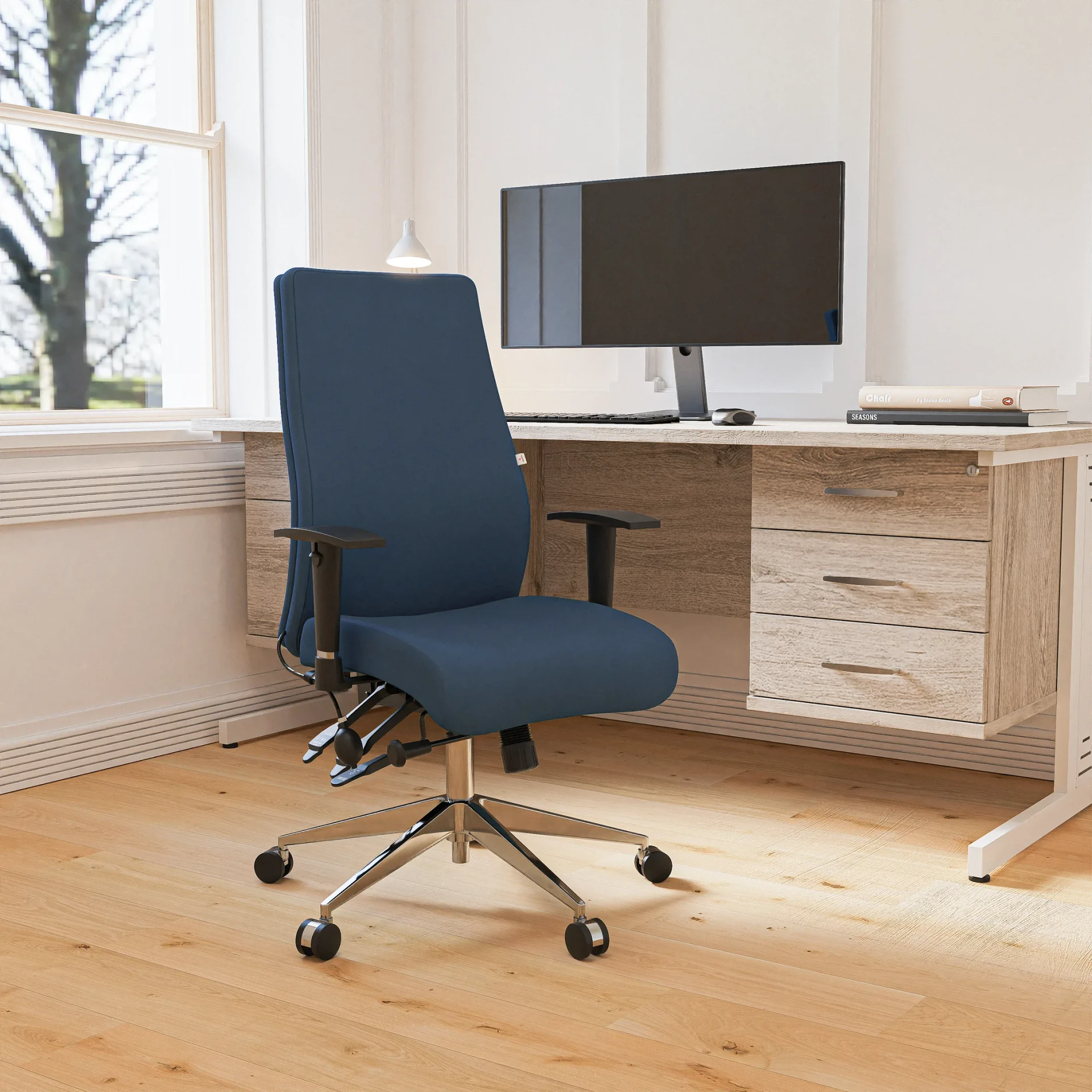
On a chair with a seat slide, this is a lever that lets the seat pan move forwards or back. The Onyx ergonomic posture chair slides between 46cm and 51cm, which covers most people. If your chair has no slide, this is the adjustment you cannot fix, and it is the one I would check before buying.
3. Tilt and tension
Unlock the tilt. A chair that rocks with you is kinder to your back than one locked upright, because the movement keeps you shifting rather than slumping. Then set the tension so the backrest supports you when you lean back and returns you upright without a shove. Heavier people need more tension, lighter people less. The tension is usually a knob under the front of the seat, and you turn it while sitting, testing as you go.
Some chairs let the seat and back angle move independently. The Onyx tips the seat forward by up to 15 degrees and sets the back across a 20 degree range, which sounds like more control than anyone needs until you have spent a day at a desk that is slightly too high.
4. Arms
Arms should carry the weight of your forearms with your shoulders relaxed, and sit just below the desk surface so the chair can pull in. If the arms hit the desk edge, you end up sitting too far away and reaching. Set them so your elbows rest at a right angle, then check the chair still tucks under. If it does not, lower them or, on chairs that allow it, take them off. The Onyx arms run from 63.5cm to 73.5cm and come off entirely. Any chair on our office chairs with adjustable arms page will give you this range of movement.
5. Lumbar
Last, because it only makes sense once everything else is right. The lumbar support should sit in the curve of your lower back, roughly at belt height. On a chair with a height adjustable back, ratchet the backrest up or down until the support meets the curve. On a pump-up lumbar, inflate it until your lower back feels held, then let a little out. Too much lumbar pushes you forward off the backrest, which undoes step two.
The ten minute test
Sit for ten minutes after adjusting and do some actual work. If you notice your shoulders creeping up, the arms are too high. If you are perching on the front of the seat, the depth is wrong. If your feet have found their way onto the chair base, the seat is too high. Adjust one thing and sit again.
None of this needs an expensive chair. It needs a chair with the five adjustments and someone willing to use them. If you are buying, the spec table on every computer and task chair on our site lists seat height range, seat slide, arm type and lumbar so you can check before it arrives. And if your chair does not have them, no amount of adjusting will get you there. That is a chair problem, and a different conversation.
Contents

Customer Experience Manager
Makes sure every order feels handled by a person, not a portal.