

Lumbar Support: What It Is, Why It Matters, How to Spot the Real Thing
Sit up straight. Now notice what your lower back did: it curved inwards, just above the hips. That curve is the lumbar spine, and holding it is the single hardest thing about sitting for eight hours. A lumbar support office chair is one built to hold that curve for you, so the muscles that would otherwise be doing it can stop. That is the whole idea. The difficulty is that almost every chair on the market claims to have it, and the difference between the good version and the bad one is about the width of a hand.
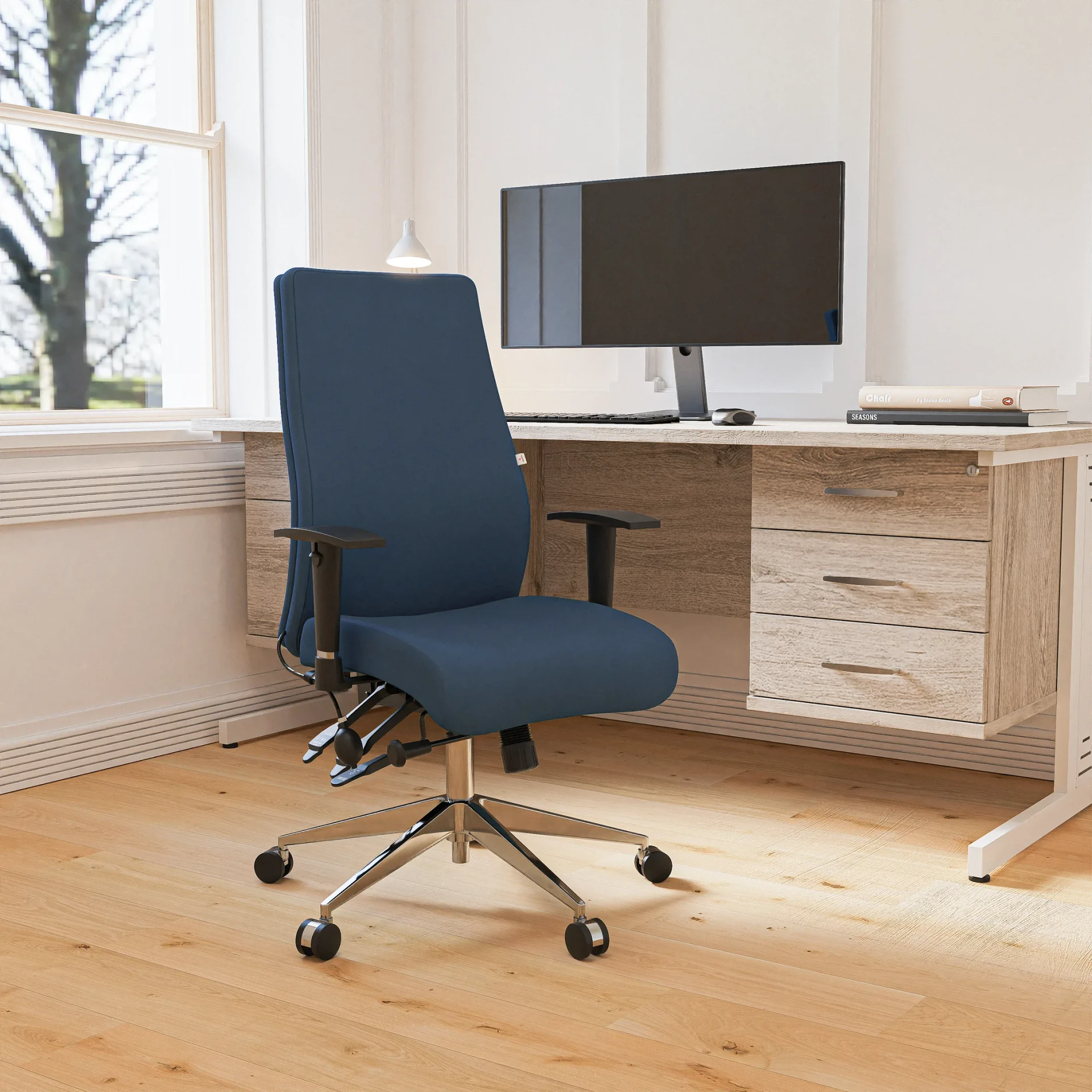
What lumbar support in an office chair actually does
When you sit down, the pelvis rolls back and the lumbar curve flattens. Flat is fine for ten minutes. After an hour the ligaments are carrying load that the curve was meant to spread, and that is the ache that starts mid-afternoon and is gone by morning. A lumbar support is a firmer section of the backrest that meets the curve and holds it in place, so the pelvis stays upright without you thinking about it. Done right, you stop noticing your back. Done wrong, you notice it more.
The support has to be in the right place, which is the catch. The lumbar curve on a person of 160cm sits lower than on someone of 190cm. A fixed bump of foam is in the right place for one of them and the wrong place for the other.
Built-in or adjustable
There are two honest kinds. Built-in lumbar support is a shaped section moulded into the backrest, and it works when the chair fits you, or when the whole backrest moves up and down to bring the curve to you. It is the cheaper option, and on a chair used by one person of average height it is often all you need. Some chairs go further. The Ergo Click Plus has a split backrest with lumbar support that follows your lower back as you move rather than sitting at a fixed depth. Our page of office chairs with built-in lumbar support gathers the chairs that take this approach.
Adjustable lumbar support moves independently of the backrest. On many of ours it is a pump: squeeze the bulb and the pad inflates forward into your back, press the valve and it comes back. Others use a slider or a dial. It is the right choice for a chair that different people use, and for anyone who has been told by a physio what their back wants. The Onyx high back ergonomic posture chair has both a shaped backrest and a pump up lumbar, on a triple lever mechanism with a seat slide, and is rated for 24 hour use at 135kg. The Domino high back posture chair does the same job with a pocket sprung seat and a 145kg capacity. Every chair we list with a pump, slider or dial is on our office chairs with adjustable lumbar support page.
How to spot the real thing
Read the spec table, not the photo. The spec table on our chairs has two rows, Integral Lumbar Support and Adjustable Lumbar Support, each a Yes or a No. A chair with a curved back and two Nos has a curved back.
Ask what moves. If the answer is the whole backrest, that is a height adjustable back, which is useful and is not the same thing. A ratchet back plus a shaped curve is a good built-in solution. A pump, slider or dial is adjustable.
Check the depth of travel, where it is given. Two or three centimetres is enough. Less than that is a switch, not an adjustment.
Sit for twenty minutes, not two. A lumbar pad that feels firm at first is often right after half an hour. One that feels like nothing at all is a bump of foam with ambitions.
Setting it up
Get the seat height right first, with your feet flat and your knees level with your hips. Then sit right back. Set the backrest height so the curve of the chair meets the small of your back, just above the belt line. Only then adjust the lumbar depth, and stop at the point where you feel held rather than pushed. If your shoulders come off the backrest, the pad is too far forward. Give it a week before you decide.
The chair we would pick
For one person at a desk all day, a chair with a good built-in curve and a height adjustable back does the job and costs less. For a shared desk, a hot-desk floor, or anyone who already knows their back is particular, pay for the pump. Our ergonomic office chairs range lists both kinds, and the spec table on every one tells you which you are getting before you spend a penny. If you are not sure which is right for someone on your team, talk to us. We would rather work it out with you first than have the chair come back.
Contents

Customer Experience Manager
Makes sure every order feels handled by a person, not a portal.