

Bench Desks: The Case for Sitting Together
Bench desks took over the modern office for reasons that had very little to do with fashion. They seat more people in the same room, they cost less per seat, and they make the cabling somebody else's problem exactly once rather than every time a desk moves. Whether that suits your office is a different question, and worth thinking about before you buy six of them.
The cost per seat argument
A bench desk shares its frame. Instead of four legs per desk, you get a run of desks on a common structure, and each extra person costs a top and a share of a leg rather than a whole desk. That is where the saving comes from, and it grows the longer the run gets.
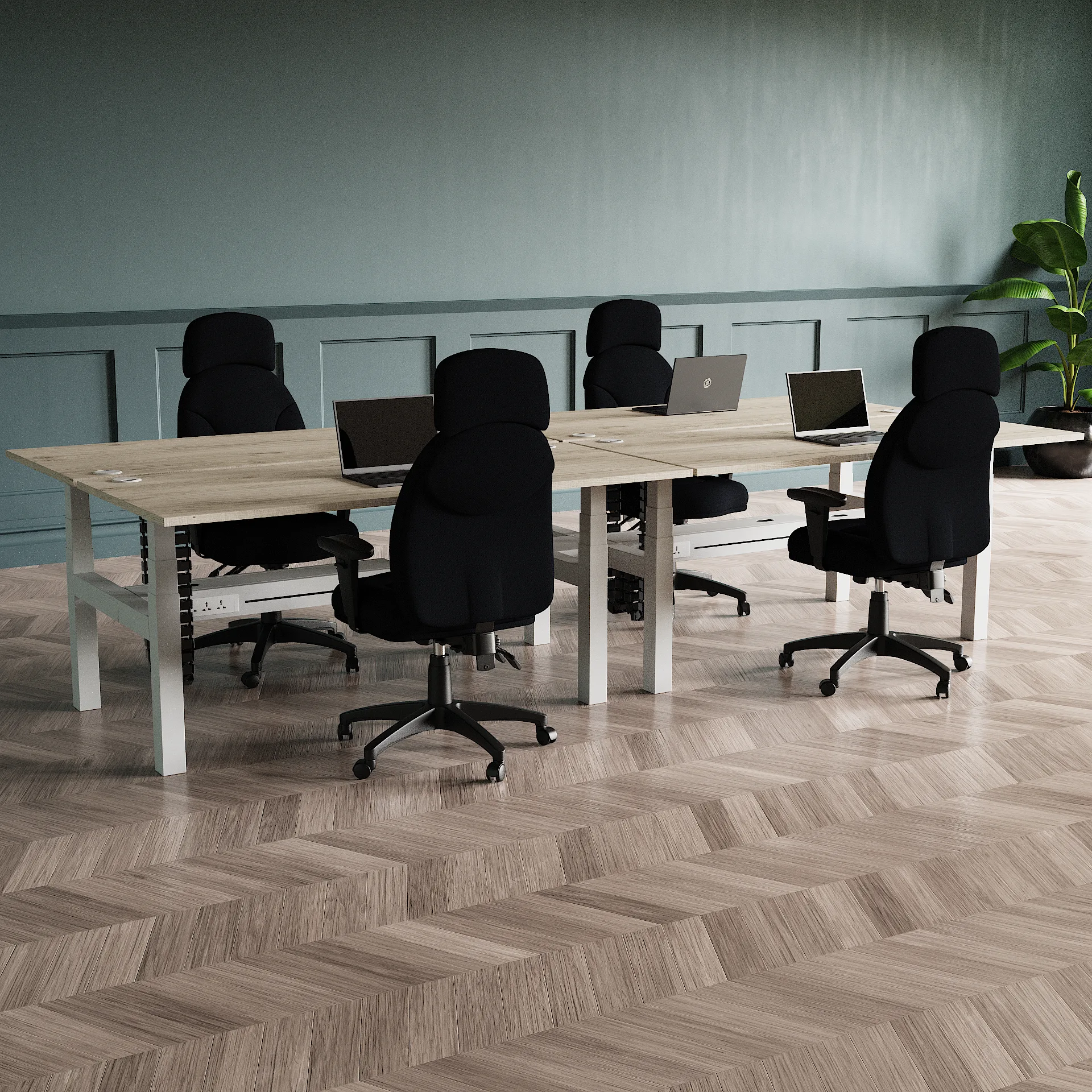
You can see it in how the products are built. A back-to-back Impulse bench desk runs from 120cm wide for two people up to 540cm for a row of six, all on one frame, 160cm deep because two people sit facing each other across it.
The second saving is cabling. One spine, one power feed, one set of trays for the whole run. Six separate desks means six of everything and six times the fiddling.
The third is floor area, and it is the one that decides most offices. Two rows facing each other share the walkway between them instead of each needing their own, so a back-to-back run of six fits in noticeably less room than six desks against the walls. In a building where you pay rent by the square metre, that is the whole argument in one sentence.
Growing without starting again
The part people miss until later is the extension kit. Buy a four person bench now and, when the team grows, an extension kit bolts two more seats onto the end of the existing frame. You are buying tops and one extra leg rather than a whole new desk system that does not quite match the old one.
This is the strongest argument for bench desking in a growing business, and it only works if you plan for it. Leave the wall space at the end of the run clear, and note down the finish and frame colour you bought. Coming back in two years and guessing which white it was is a miserable job.
Buy the run you need now, and leave room at the end for the run you will need later.
Planning the sizes
Bench desks come in fixed increments, so the maths is less flexible than with individual desks. Work it out on paper first.
Per person, 120cm of width is generous, 140cm is comfortable and 160cm is the norm where people have two screens and paperwork.
Back-to-back runs are typically 160cm deep in total, giving each side 80cm. Single row benches sit against a wall at half that depth.
Leave 700mm behind each seat for the chair, and a walkway on top of that. A six person bench with no room to get out of the middle seat is a design nobody will forgive you for.
Check the height under the top if pedestals are going underneath. The Impulse gives 65.5cm of clearance, which a standard mobile pedestal fits under comfortably.
Where bench desking is the wrong answer
It is not universally right and I would rather say so. Facing somebody all day suits some teams and quietly grinds on others. If your people are on calls constantly, a run of six with nothing between them is a noisy, distracting arrangement, and you will end up buying screens anyway.
It also assumes a settled layout. Bench desks are heavy, they bolt together, and they are not a system you shuffle round on a Friday afternoon. A back-to-back run for six weighs upwards of 350kg assembled. If your office rearranges itself every few months, individual desks will annoy you less.
If it does suit you, the bench desk range lists widths, depths, clearances and which extension kits fit which frames, so you can plan the full run and the one after it before you spend anything. Widths have pages of their own too, so you can look at just the 140cm office desks or the 160cm office desks.
Contents

Product Manager
Picks the ranges and knows which chair suits which back.