

Bar Stools for Work: Poseur Height Seating That Lasts
A task chair has an easy life by comparison. It gets sat on, adjusted now and then, and rolled about on a carpet. Office bar stools get dragged across hard floors, climbed onto, leaned against, stood on to reach the top shelf and kicked every time somebody sits down. They take more abuse than any seat in the building.
So when I look at office bar stools, the first thing I ask is what state a stool will be in after a year of that. How it looks at the poseur table comes second.
Start with the usage rating
Every seat we sell has a recommended usage figure in its spec table: the number of hours a day it is built to be sat on. On bar stools it varies a lot, and it is the quickest way to sort them.
Our Brayford and Charford bistro stools are rated for four hours. That is honest, and it suits a café counter where people perch for a coffee and move on. The Carmen high bar stool is rated for six. The Florence high bar stool and the stackable Turin are rated for eight.
If people are going to work at a high bench, hot-desk at a tall table or spend a long afternoon on a stool, buy an eight-hour one. If it is for the kitchen counter, four is plenty, and you can spend the difference elsewhere.
Weight capacity is worth a look too. Most of our bar stools are rated to 110kg. The Carmen goes to 125kg.
The footrest takes the punishment
On a high stool, your feet do not reach the floor, so they go on the footrest. Every heel and every scuff lands there, along with everyone who uses it as a step.
That makes the footrest the first part to show wear, and the thing to look at hardest. A footrest should be a solid bar, fixed at a height your feet can actually reach. A ring set too low leaves your legs dangling. The Turin has two footrests, which gives people a choice of where to put their feet.
Expect the finish on a footrest to mark over time, whatever it is. A dark frame hides it better than a pale one.
Frames and covers
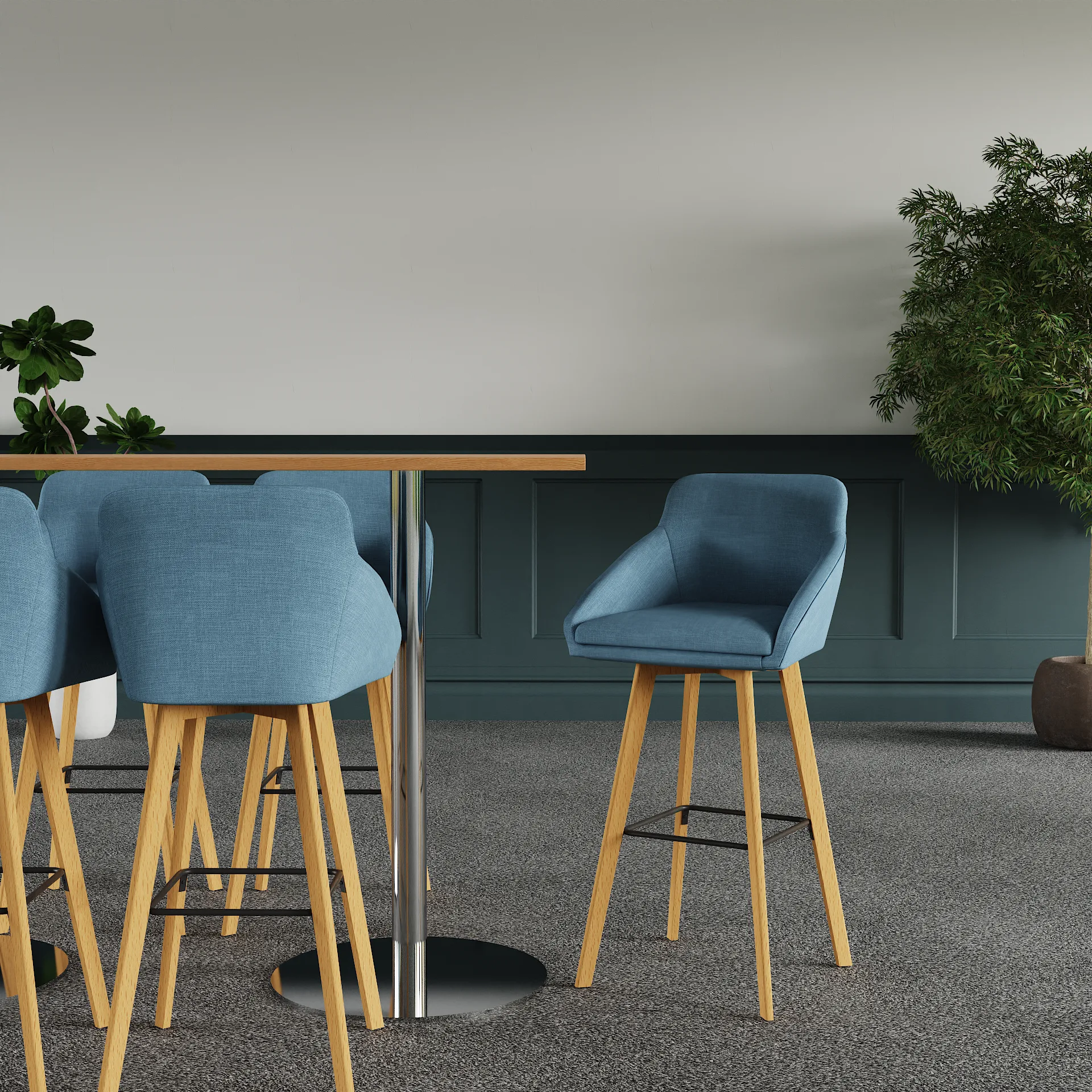
Metal frames shrug off knocks. Wooden frames look warmer and suit a breakout space that is trying not to look like an office, but they will show a dent where a metal one would not. The Carmen's wooden frame is a deliberate choice of looks over toughness, and in a reasonably civilised office it is a good one.
For the seat, think about what will be spilt on it. Fabric is comfortable and warm. A wipe-clean cover is easier near food and drink. If a stool will live by the coffee machine, that matters more than the colour.
Arms are a mixed blessing. They make a stool feel like a proper seat and help people climb up. They also make it wider, and harder to tuck under a table. Check the table before you choose arms.
Fixed or swivel
All of the stools in our bar stools range are fixed height with no swivel, and for a poseur table that is usually what works best. A fixed stool stays where you put it, lines up neatly round a table, and has no mechanism to wear out.
A swivel is worth having where people need to turn and get on and off often, at a fixed counter or a tall workbench. In that case look at a draughtsman chair instead. The Malaga washable hi-rise draughtsman chair has gas height adjustment from 58.5cm to 73cm, a wipe-clean polyurethane cover and an eight-hour rating. It is less pretty than a bar stool, and much better for a working day.
Heights that match
Get the height right and everything else is easier. Our Florence and Carmen stools have 80cm seats, which suit our 114.5cm poseur tables. The Turin's 70cm seat suits a lower counter. Brayford and Charford sit lower again. I went through the sums in our poseur tables and bar stools guide, so I will not repeat them here.
If you are buying for a breakout area, the whole range is in our bar stools category, each with its seat height, usage rating and weight capacity on the page. Work out how long people will sit, then choose the look. The other way round is how stools end up in the skip after eighteen months.
Contents

Product Manager
Picks the ranges and knows which chair suits which back.