

"Which One Should I Get?" How We Answer the Only Question That Matters
Nearly every conversation I have ends up at the same question, however it starts. Somebody has a room, a headcount and a number in mind, and what they want to know is which one should I get. That question is the job. The office furniture advice is the thing we actually provide, and the furniture is what turns up afterwards.
Why the question is hard to answer honestly
In this trade the usual reply is a phone call, and the phone call is a sizing-up. How many are you buying, what is the budget, who else are you talking to. Answer those three and the price arrives shaped to fit what you seem able to pay. I spent long enough on the inside of that to know exactly how it works, and it is the reason Deskwell exists.
Our prices sit on the product page and are the same for every business customer. That removes the guesswork, and more usefully it removes the incentive. If every option costs what it says it costs whoever is asking, there is nothing in it for me to walk you up the range.
What that looks like on two real chairs
Take two task chairs we sell. The Portland medium mesh back is rated for eight hours a day, carries up to 125kg and has a seat height of 44 to 54cm. The Chiro is rated for 24 hours, carries up to 150kg, and adjusts from 48 to 60cm with a medium or high back.
The Chiro is the better chair. It is also more chair than most people need. If you are kitting out a control room, a ward, or any shift pattern where the seat never gets cold, the 24 hour rating is the entire point and I would push you towards it. If your team goes home at half five, the eight hour chair is the right answer, and that is what we will tell you.
There is a catch in that advice, and it is the sort of thing a spec table will tell you if somebody points at the right row. The Portland tops out at a 54cm seat height. The Chiro carries on to 60cm. Put a six foot four colleague on the cheaper chair and they will spend a year with their knees higher than their hips, which no amount of lumbar support fixes. Same team, same order, and the honest recommendation splits down the middle: the eight hour chair for most of the desks, the taller-adjusting one for the two people who need it.
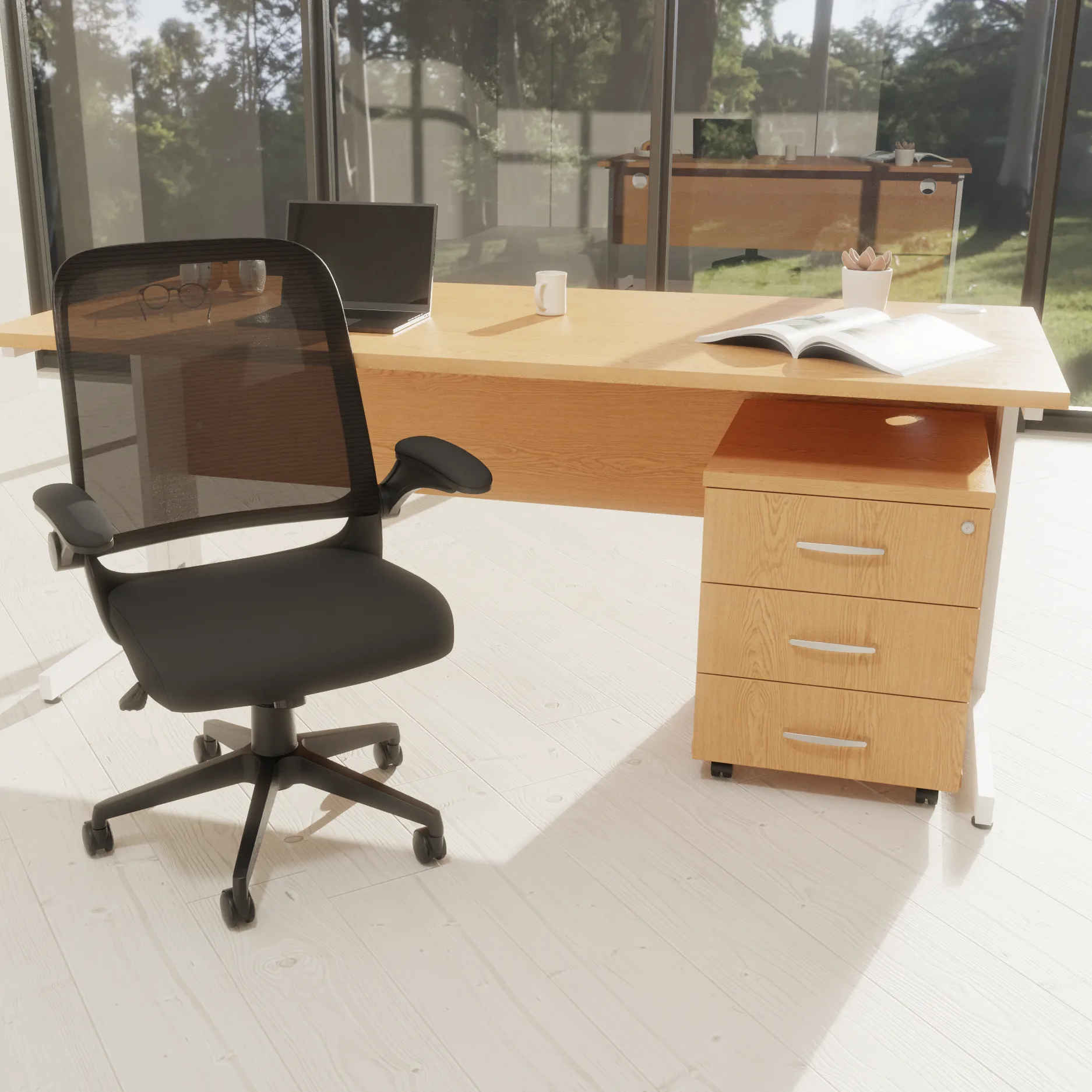
Desks work the same way. A height adjustable desk suits somebody who will genuinely use the up button a few times a day. For anybody else it is an expensive way to own a desk that stays at 72cm, and the money does more good spread across the rest of the office desks on the floor. We would rather say that before you order than read it in an email six weeks later.
If the cheaper thing is the right thing, the cheaper thing is what we recommend. There is no clever version of that policy.
The questions we ask before recommending anything
There are only three, and none of them is about your budget:
How many hours a day will somebody actually be in it?
Who is it for, and are they roughly the same shape as everyone else on the team?
What happens when something goes wrong with it in year two?
The answers usually settle it. A room of people doing six hour days on standard-issue frames needs a sensible chair and a decent guarantee, not the top of the range. Somebody at 110kg doing twelve hour shifts needs the rating, and no amount of budget-trimming makes that optional.
We are happy to sell you less
A fair number of the chairs we recommend sit in the office chairs under £250 part of the shop, and that is a proper section rather than a consolation shelf. Spending more than you need to is not loyalty, and it does not make the next conversation easier.
So tell us the room, the hours and the people, and we will tell you what we would buy in your position. Sometimes the answer is the dearer one and we will explain why. Often it is not.
Contents

Managing Director
Runs the place, answers the phone, and walks Oscar - the buck stops with him.