

Corner and L Shaped Desks: More Surface, Same Footprint
A corner office desk solves a specific problem: you need more surface than a straight desk gives you and the room has no more wall to give. The crescent shape puts the extra depth in the corner, where a straight desk leaves a dead triangle, and the footprint along each wall stays the same. That is the whole case for one. The rest of this post is about whether that case applies to your room, and how to find out before the desk arrives.
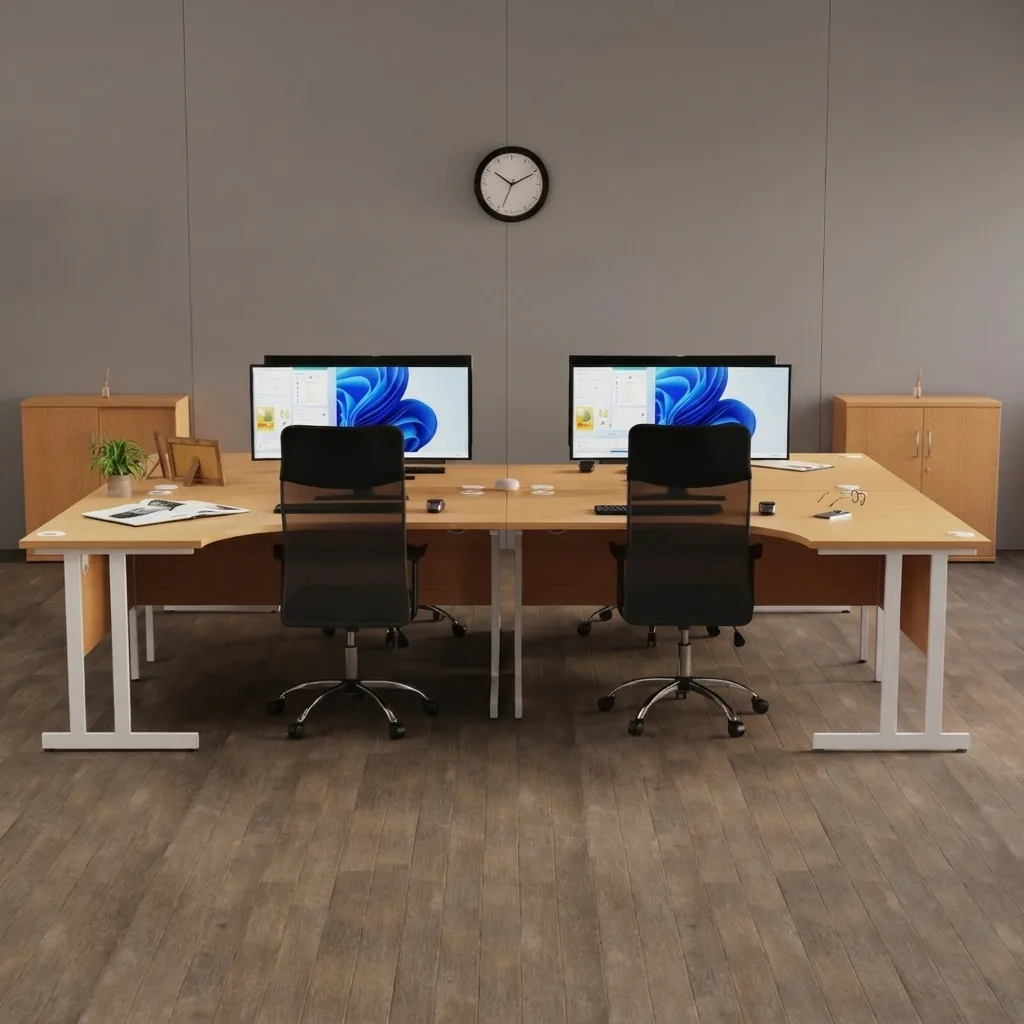
What you actually get
Take the Impulse cantilever crescent corner desk as the reference. It comes in 120, 140, 160 and 180cm widths, is 120cm deep into the corner, and stands 73cm high on a 25mm top rated to 135kg. You choose left hand, right hand or a square corner, one of seven finishes, and a black, silver or white frame. The guarantee is ten years. The panel end version is the same desk on panel legs, and adds two-tone finishes where the top and the ends differ.
The number that matters is the 120cm depth. A straight desk is usually 80cm deep. The corner desk gives you 40cm more in the corner, which is exactly where two monitors want to sit. Dual screens on a straight desk push the keyboard to the edge. On a crescent they sit back in the deep part and the keyboard has room in front of them. If you run two screens, that is the reason to buy one. If you run a laptop, it probably is not.
Left or right
The hand is the part people get wrong, and it is the part you cannot fix on delivery day. It describes which side the longer return sits on when you are at the desk. Every product page states it, and the 3D model settles it: turn the desk until it matches the corner in your room, and the wall the return runs along is the wall it needs in your office. The page also has a view in your room option, which puts the desk in your actual corner through your phone camera. It is a two minute check that saves a fortnight.
Measure before you fall for the photo
Product photographs are shot in rooms with no radiators, no sockets and no doors. Your room has all three. The measuring is simple, and it is the bit that decides whether the desk works.
Measure both walls out from the corner. The desk width applies to one wall and the 120cm depth to the other, so note which is which.
Subtract anything on those walls: radiator, socket, window sill below 73cm, the swing of the door. A desk that clears the wall but blocks the radiator is a cold desk.
Add the chair. You need about a metre from the front edge of the desk for someone to sit down and stand up without hitting anything behind them.
Check the route in. The top is one piece, and at 180cm it has to get through the door and round the landing.
If the numbers work at 160cm, that is where most people land. If you have the wall for it, the 180cm office desks page shows every desk at that width, corner or straight, and 180 is where two screens and paperwork stop fighting for the same space.
When a corner desk is the wrong answer
If the room has no free corner, a corner desk becomes a large desk in the middle of a wall with a lump on one side. Buy a straight desk. If the room is a home office and the desk has to disappear at six, the Fleur has a 130cm top that rotates on castors, opening into an L shape when you work and closing over its shelves when you finish. It lives in our corner and L shaped desks category alongside the crescents because that is where people look for it. Every measurement above is on the page for every desk. Spin the model, measure the walls, and the photo will not catch you out.
Contents

Web Developer
Keeps the site quick, honest and free of the usual dark patterns.